
I remember LBJ’s War on Poverty. When I was a student at Antioch College I worked as a teacher’s aide in an elementary school in Harlem. It was funded by ACTION (predated VISTA) one of many anti-poverty programs funded by the Economic Opportunities Act of 1964. The Act was essentially repealed when Reagan took office, though Head Start and some other programs survived under different agencies and a block grant program. These programs were supported by Democrats and have been attacked by Republicans, even today. The fact is, according to the U.S. Census, the poverty rate in 1964 was 19% and it was reduced by 1973 to 11.3%.
More recently, the Child Tax Credit increase in 2020 during the pandemic lifted almost 3 million children out of poverty (45% reduction by 2021), but the increase lapsed in 2022 and 41% of children fell back into poverty.

I cite these familiar examples to state the obvious: policies can reduce poverty. Can we end poverty? Of course we can. Yes, the culture we swim in obscures the simplicity of the solutions, but any doubts are answered by Matthew Desmond’s book, Poverty, By America. His careful analysis explains how our policies prioritize the subsidization of affluence over the alleviation of poverty. Short on time? Listen to the author on YouTube in a conversation with Damien Paletta on Washington Post live. Desmond calls us to become Poverty Abolitionists and begin to address the profound moral crisis in America (and, by inference, globally).
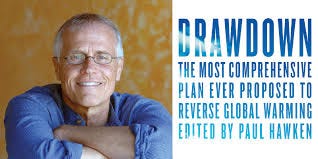
Paul Hawken, in his book and website, Regeneration, describes the agencies, programs, and services run by private sector businesses that address poverty as an extractive Industry. According to Hawken: “In the United States, there is a vast network of for-profit “human service” corporations, funded by state and federal agencies, that form a business empire worth hundreds of billions of dollars.” Similarly, funding for prisons is an $80 billion dollar industry in the U.S. serving the 2.3 million in jail, and 4.4 million on probation or parole. Half of these people committed minor, nonviolent offenses. The point is these industries now depend upon and advocate for the expansion of their services, as opposed to advocating for policies that reduce poverty or promote alternatives to incarceration.
Hawken’s Regeneration and his research teams in Project Drawdown work to reverse the planet’s existential threat from global warming. Hawken, along with many others like Naomi Klein in This Changes Everything, concludes that “To change everything, we need everyone.” Paul Hawken therefore connects the environmental crisis with Poverty, and insists that we must first address, engage, and solve poverty IF we are to succeed in efforts to reverse global warming and create a sustainable future.
Connecting poverty and climate change may seem odd or even strange to those of us who have rarely, if ever, been in the same room with a family living in poverty. Our neighborhoods are effectively redlined by the cost of housing so we don’t even see poor people. They typically don’t attend our houses of worship, and if we happen to stop in a Dollar General store we are not likely to see anyone we know.
A recent article by Phil Wilson, Poverty and Climate Overheating: Flip Sides of One Coin, published by Reslience.org reminds us in detail how corporate interests manage to extract wealth from poor people. Wilson, now a retired mental health worker for decades, put it this way: “The diseases overrepresented in impoverished communities — obesity, diabetes, emphysema, osteoporosis, HBP, asthma, coronary blockage, mental illness, etc. — are deeply entwined with shrinking habitats and overheated climate. We might even think of poverty and climate as a single, indivisible issue.”
Think of the environmental impact of Fast Food chains like McDonalds, Wendy’s, Burger King etc. due to their sourcing beef from the Amazon, packaging from old growth forests, and use of plastic made from fracked gas. Linking poverty with food choices that impact the greenhouse gas emissions (in addition to the health impacts of the fast food industry) is a good start, but poverty is the underlying cause of most of the major ills of society: affordable housing (and the unhoused/homeless), income and wealth inequality (minimum wage gap with living wage), crime (and punishment), lack of health care, poor education outcomes, etc. Most people have no idea that the U.S. education system is #2 in the world (Finland is #1) but oh wait: it’s true only if you discount poverty.
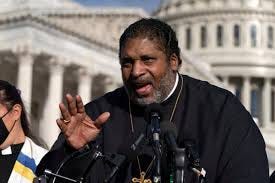
Enter Rev. Dr. William Barber II (click for background), the minister and social activist whose work in North Carolina includes leadership in the NAACP and, most notably, he formed a large coalition of 99 organizations to fight racism and demonstrate on “Moral Mondays” at the NC legislature. In 2014 Barber formed the Poor People’s Campaign: A National Call for a Moral Revival in honor of the original 1968 campaign founded by Martin Luther King Jr.
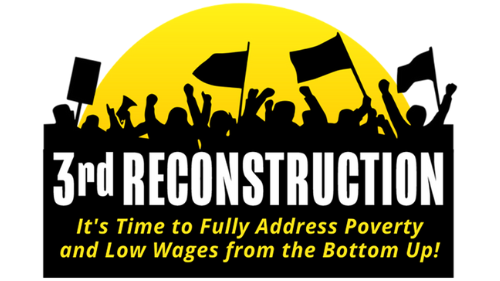
From the Poor Peoples Campaign website:
“Drawing on the transformational history of the First Reconstruction following the Civil War and the Second Reconstruction of the civil rights struggles of the 20th century, the Third Reconstruction is a revival of our constitutional commitment to establish justice, provide for the general welfare, end decades of austerity, and recognize that policies that center the 140 million poor and low-income people in the country are also good economic policies that can heal and transform the nation.”
Barber calls his coalition building strategy, “fusion politics.” He provides a 14-point framework of strategies designed to implement a long term movement, as opposed to a campaign to address any single issue or event. Here is an outline of the 14 point fusion political movement. A more detailed listing is available. https://retakeourdemocracy.org/reverend-wm-barbers-14-point-fusion-political-movement/
#1. Organize Locally & Engage in indigenously led grassroots organizing across the State.
#2. Use Moral Language.
#3. Incorporate Civil Disobedience.
#4. Use the Voices of Everyday People.
#5. Recognize the Centrality of Race.
#6. Build a Broad Diverse Coalition Including Moral & Religious Leaders.
#7. Diversify the Base by Seeking Unlikely Allies.
#8. Build a Transformational Movement that doesn’t Measure Success Based upon Elections
#9. Make a Serious Commitment to Academic and Empirical Analysis of Policy.
#10. Coordinate Use of All Forms of Media and Social Media
#11. Engage in Voter Registration and Education.
#12. Pursue a Strong Legal Strategy.
#13. Engage the Cultural Arts.
#14. Resist the “One Moment” Mentality.
Barber’s approach is comprehensive and “intersectional” in that he engages unlikely allies (see #7) to form statewide coalitions that include moral and religious leaders, academic and policy makers, legal strategies, voter registration groups, and the cultural arts. He warns against “transactional” relationships — e.g., we will support your cause if you support ours. There is a strong emphasis on a moral commitment in all aspects of the movement.
For many reasons, morality is rarely invoked as a motivating force among policy makers and government agencies. There are important exceptions. Bernie Sanders, AOC, the Squad and a growing progressive caucus in the U.S. Congress, as well as socialist voices in Latin America and internationally, speak forcefully against wealth inequality, hunger and food insecurity, homelessness, and poverty. However, neoliberal economic policies continue to drive the global consumer culture’s materialism in the West and Russia, China, India, Brazil, Japan et al have adopted this culture.
What will it take to end poverty?
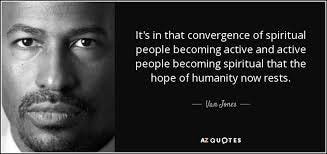
It’s understandable in today’s polarized political environment that many people despair of any prospect for large scale societal change. The quote above from Van Jones offers an important clue that change will emerge when spiritual people join with activists in a new planetary awareness of the need for change in our failing political, economic, and social institutions.

The Cultural Creatives. Sociologist Paul Ray and psychologist Sherry Ruth Anderson, wrote a prescient book in the year 2000 called The Cultural Creatives: How 50 million people are changing the world. The authors describe the majority of Americans as either “traditionalists” who identify as politically conservative, religious, and resistant to change, and “modernists” who tend to be success oriented, secular, materialistic, and pragmatic. The “cultural creatives” represent a gradual evolution of people who no longer fit into these categories . The authors characterize them as “open to change, like to travel, see nature as sacred, identify with green values, and view relationships as important.”
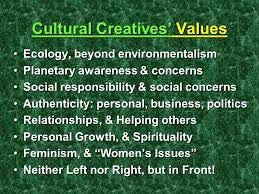
The slide above from a presentation by Paul Ray outlines the values of the cultural creatives. Ray believes that this new demographic will function as the carrier population in the transition to a new culture rooted in green values. that have emerged from the social and environmental movements from the 1960s until today.
Such a transition away from the materialism of the global consumer society to a more nature-focused culture rooted in ecological and spiritual values opens the opportunity to approach the economic, social, and political problems of poverty with the moral sensibility that has been ignored by consumerism.
Evolution, whether cultural or biological, offers no guarantees that a transition to a new life form or a new culture will be successful. Climate change, our stubborn insistence on economic growth at the expense of nature’s ecosystems, corporate capture of government regulatory systems, record levels of wealth inequality, even the threat of nuclear war — underscore the need to reclaim democracy and begin the process of co-creating livable futures. Are we up to the challenge? Paul Hawken’s quote below captures our dilemma we face in the challenge to reinvent everything. Is it a burden or the opportunity to change the world?
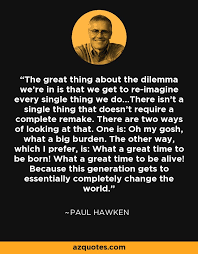
We get to decide. A good place to start is to eliminate poverty. Let’s all become poverty abolitionists.

A lot to chew on here. One thought I have had over many years is that it is the poor that have contributed least to climate change. The poor ride the bus; I drive a car. So it was interesting to think about how limiting poverty could help the environment.–ie, not fueling the McDonalds of the world. But it is true that as we have more we consume more and contribute to climate change, so we need to eliminate poverty while helping the rich get “poorer” so they stop consuming so much
Well said, Kathleen. Contribute the least and, in many ways, first and worst impacted by climate change. So unfair on so many levels it seems to me. But to focus on “Simply Living” no matter your income. I’ve often thought about Warren Buffet (and maybe other million/billionaires who live simply) (is this very relative in this example?). I’ve been by his house in Omaha – small house, small swing on the porch, one car garage, a bike on the porch. . .I couldn’t believe it! So getting the rich who care and those of means to redo things: reuse, recycle, upcycle, restore, re-gift but not replace is a big message here. But that should not preclude our developing habits and policies that center the poor (working and low to no income especially) to lift people up. What a balance of messaging we have before us!